Alzheimer’s disease (AD) is one of the most prevalent neurodegenerative disorders worldwide. In recent years, sleep–wake rhythm disturbances have been recognized as an important early biological marker and pathological risk factor for AD, often emerging decades before the onset of cognitive impairment. However, the key brain regions involved and the underlying neural mechanisms remain poorly understood, hindering the development of effective early intervention strategies. Recently, a research team led by Dr. HE Kai-Wen at the Interdisciplinary Research Center on Biology and Chemistry, Shanghai Institute of Organic Chemistry, Chinese Academy of Sciences, published a study entitled “Impaired adrenergic regulation of Kv channels underlies LC hyperactivity and early-onset sleep disruption in AD-like amyloidogenic mice” in the journal Alzheimer’s & Dementia, systematically elucidating the neural mechanisms underlying early sleep disturbances in AD. Using the 5xFAD transgenic mouse model of AD, the researchers combined sleep–wake monitoring, whole-cell patch-clamp electrophysiology, and pharmacological interventions to investigate alterations in neural activity. They found that as early as 2 months of age, 5xFAD mice exhibited dark-phase–specific hyperarousal and impaired brain state transitions. Mechanistic analyses revealed that locus coeruleus (LC) neurons displayed a phase-specific increase in spontaneous firing rates during the dark phase. Further investigation demonstrated that this abnormal hyperexcitability was driven by Aβ oligomer–induced disruption of α2A adrenergic receptor function, which normally maintains LC neuronal excitability within a physiological range. This disruption impaired the receptors’ regulation of two key voltage-gated potassium channels, Kv4 and Kv7, which act as critical “brakes” on neuronal firing. As a result, LC neurons became abnormally hyperexcitable during the dark phase, leading to sleep–wake rhythm disturbances. Importantly, the team showed that pharmacological activation of α2A adrenergic receptors or enhancement of Kv7 channel function effectively restored normal LC neuronal activity and significantly improved sleep–wake rhythms in AD model mice. 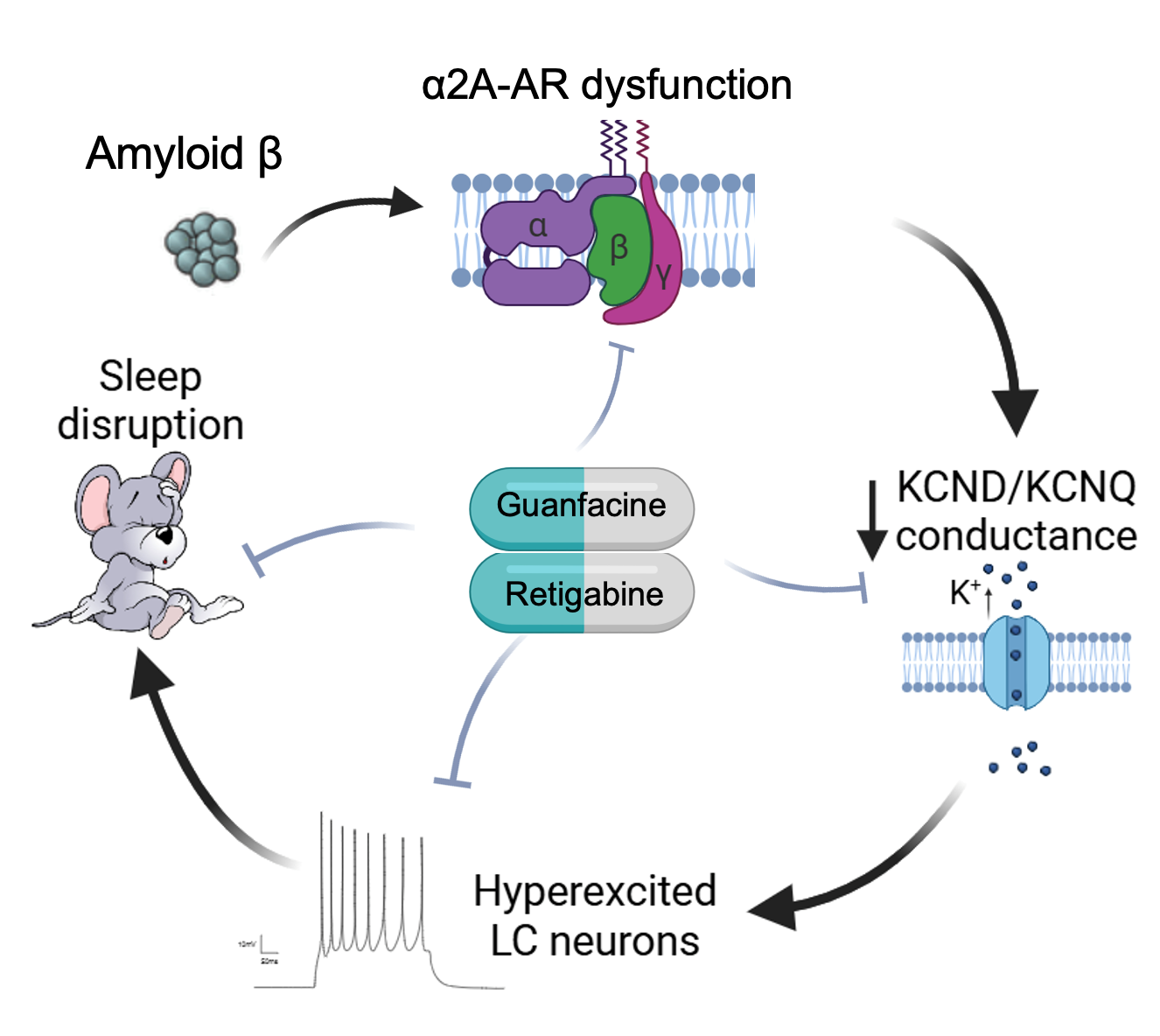
Figure 1. Working model of the mechanism for early sleep disturbances in Alzheimer's disease. This study not only identifies the locus coeruleus as a key brain region driving early sleep disturbances in AD but also elucidates the molecular and circuit mechanisms underlying these changes. Moreover, it highlights α2A adrenergic receptors and Kv7 potassium channels as promising therapeutic targets for early intervention, providing new insights for the development of precision treatments targeting prodromal sleep symptoms in AD. The first author of the study is Dr. ZHANG Yi-Ci, a doctoral graduate of the Interdisciplinary Research Center on Biology and Chemistry at the Shanghai Institute of Organic Chemistry, Chinese Academy of Sciences. Dr. HE Kai-Wen is the corresponding author. This work was supported by grants from the National Natural Science Foundation of China, the Shanghai Municipal Science and Technology Commission and the Lingang Laboratory. Original article link:https://alz-journals.onlinelibrary.wiley.com/doi/10.1002/alz.71127
|


